
A pitch deck wants a board. A streamer wants an animatic. A book signing wants a comic. Same story, three deliverables. The cheap way to make all three is to reuse the work that already exists.
01The problem
Comic creation, traditionally, is its own pipeline: a separate writer with a separate script format, a penciller working from references, a letterer placing balloons, a designer doing print prep. Studios that want both a comic and an animation usually build the comic from scratch, and end up with two visions of the same characters.
That's wasteful and it's a continuity hazard. The comic version of the hero shouldn't look like a different person.
02The approach
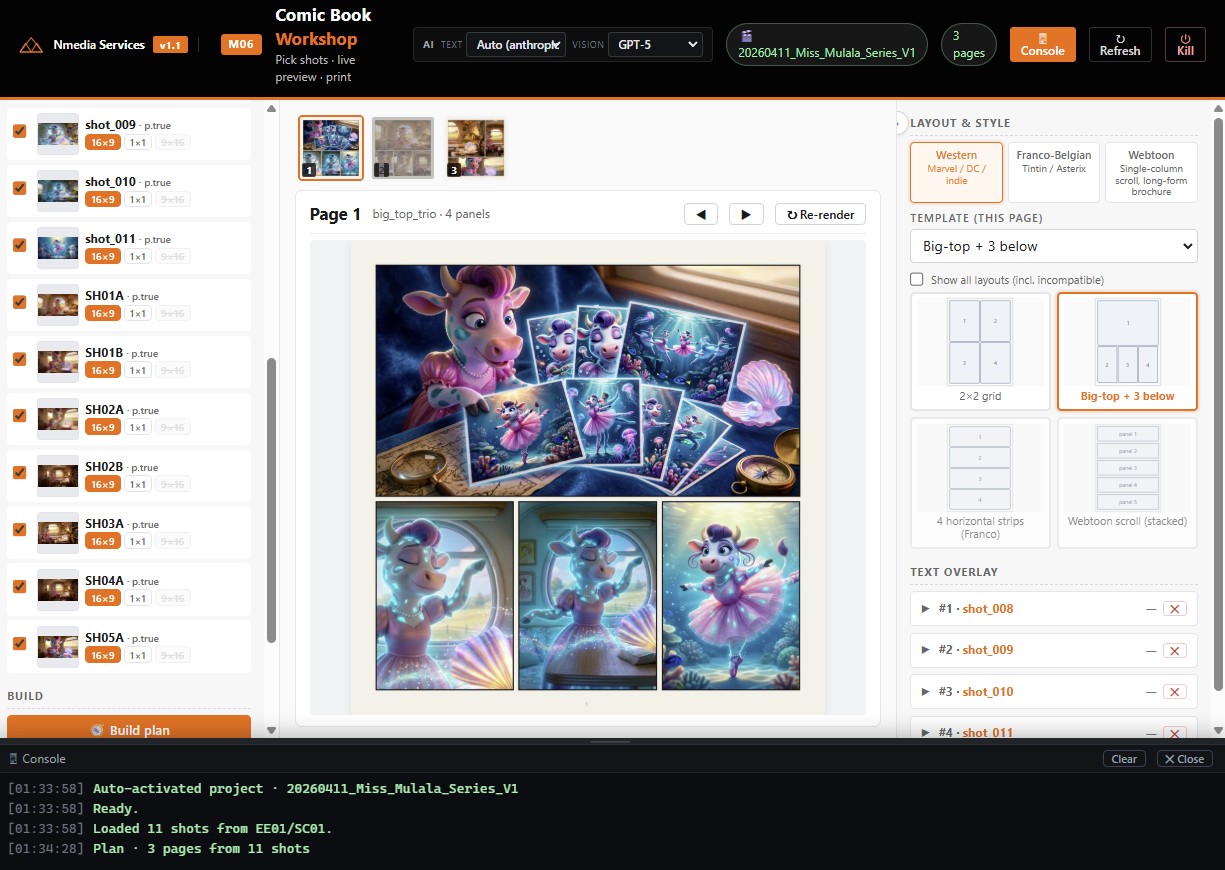
Module 06 (Comic) hooks the same project files Module 06 (Animation) uses. Cast sheets, episode variants, script scenes, storyboard shots. They're already on disk. The comic generator's job is to compose pages: pick which shots become panels, lay out the gutter, place dialogue balloons from the script's speaker tags, drop in SFX onomatopoeia for action beats.
The page layouts come from a small library of grids (three-tier classic, splash-page hero, six-panel grid, european-style nine-panel) and the panel ordering follows the script's scene order by default. Operators rearrange visually; the underlying script reference stays intact.
"It's not a separate product. It's the same show, printed on paper."
03Inside the control panel
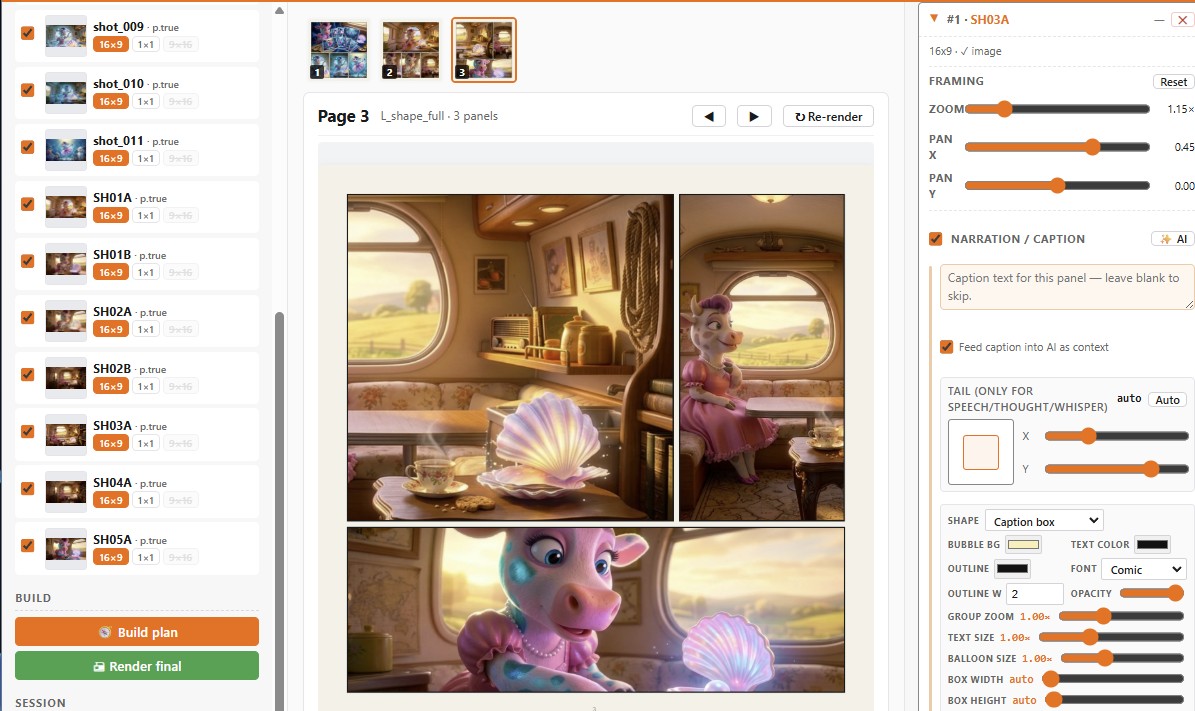
The panel reads like a comic editor's worktable. Pages on the left, panel grid in the middle, balloons and SFX as overlays.
- Layout templates. Pick a grid, the panels auto-fill from the script's shot list. Reorder by drag.
- Auto-balloons. Speaker tags from Module 02 become correctly-tailed balloons placed near the speaking character. Manual nudge available.
- SFX library. Action beats from the script trigger onomatopoeia suggestions ("KRAK", "WHRRR") with editable typography.
- Print export. CMYK PDF with bleed, trim and safe-area marks. Ready for the printer without a separate prepress pass.
04What's next
We're prototyping motion-comic export: take the comic page, animate the panels with subtle parallax and sound, and ship it as a vertical-scroll asset for social. The boundary between "comic" and "animation" is already fuzzier than the industry pretends. We're leaning into it.