
A storyboard is the first place a script meets a camera. Get the camera wrong here and every downstream module (animatics, animation, polish) is rebuilding from a bad foundation.
01The problem
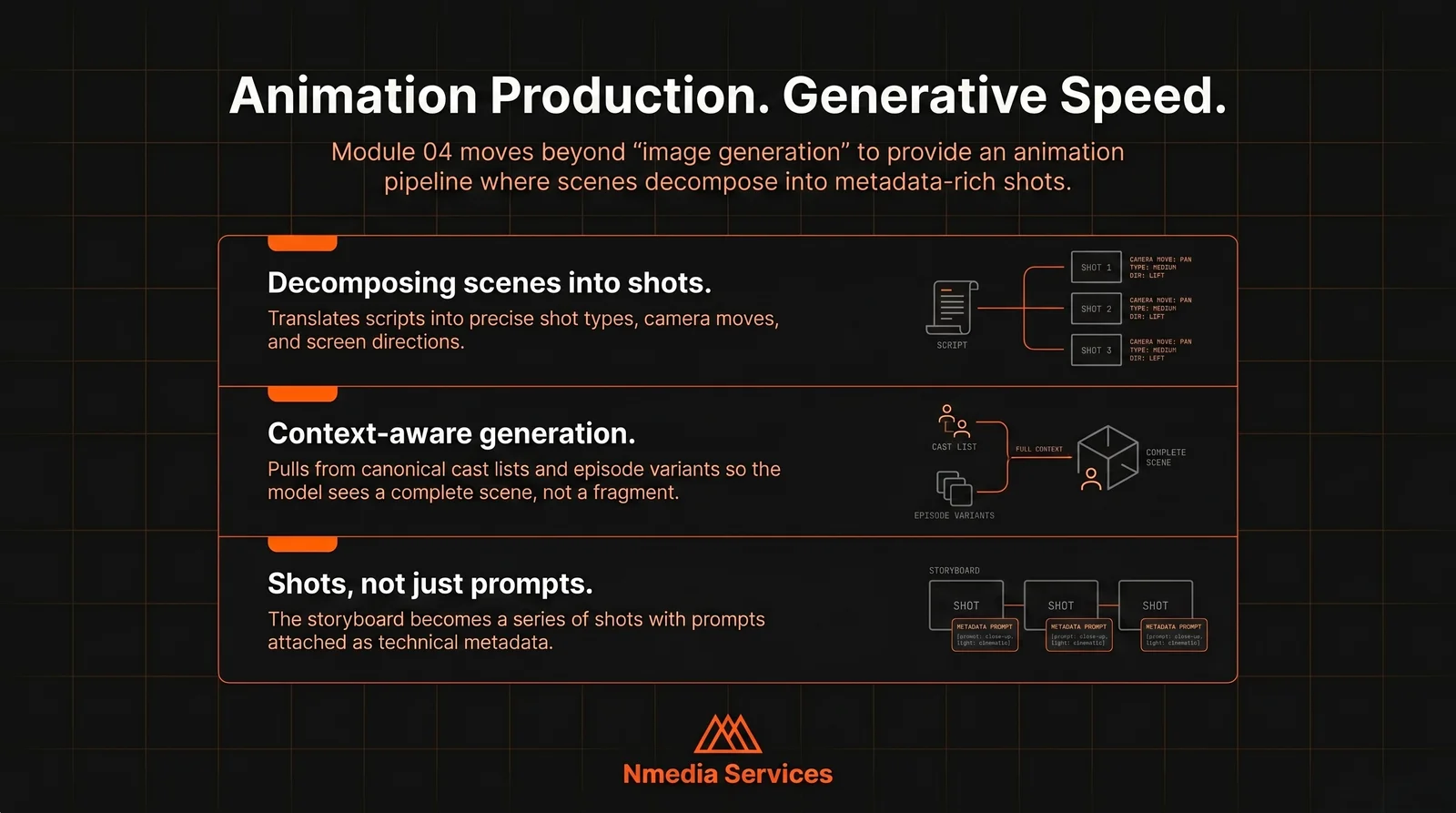
The honest version: most "AI storyboard" tools are image generators with extra steps. They take a sentence and draw something. That's a thumbnail, not a storyboard. A real storyboard knows the shot type (CU, MS, WS), the camera move (push-in, dolly, lock-off), the screen direction (left to right, eyeline match), and which characters from the cast are actually in frame. Sentences alone don't carry that.
So board artists end up writing five-hundred-word prompts per panel, or hand-painting keyframes from scratch. Either way, the tool's "speed advantage" evaporates by panel twenty.
02The approach
Module 04 reads structured input from Module 02 (script scenes) and Module 03 (cast variants). Each scene is decomposed into shots by an LLM that knows the show's grammar. Established shot types, preferred camera language, the cast members in scope. The shot list is editable before any image is generated.
Then the prompt enrichment runs: every shot gets a long-form image prompt that injects the canonical cast description, the variant outfit, the environment plate, the lensing intent and the framing. The image model sees a complete scene description, not a fragment.
"The board stopped being prompts. It started being shots, with prompts attached as metadata."
03Inside the control panel
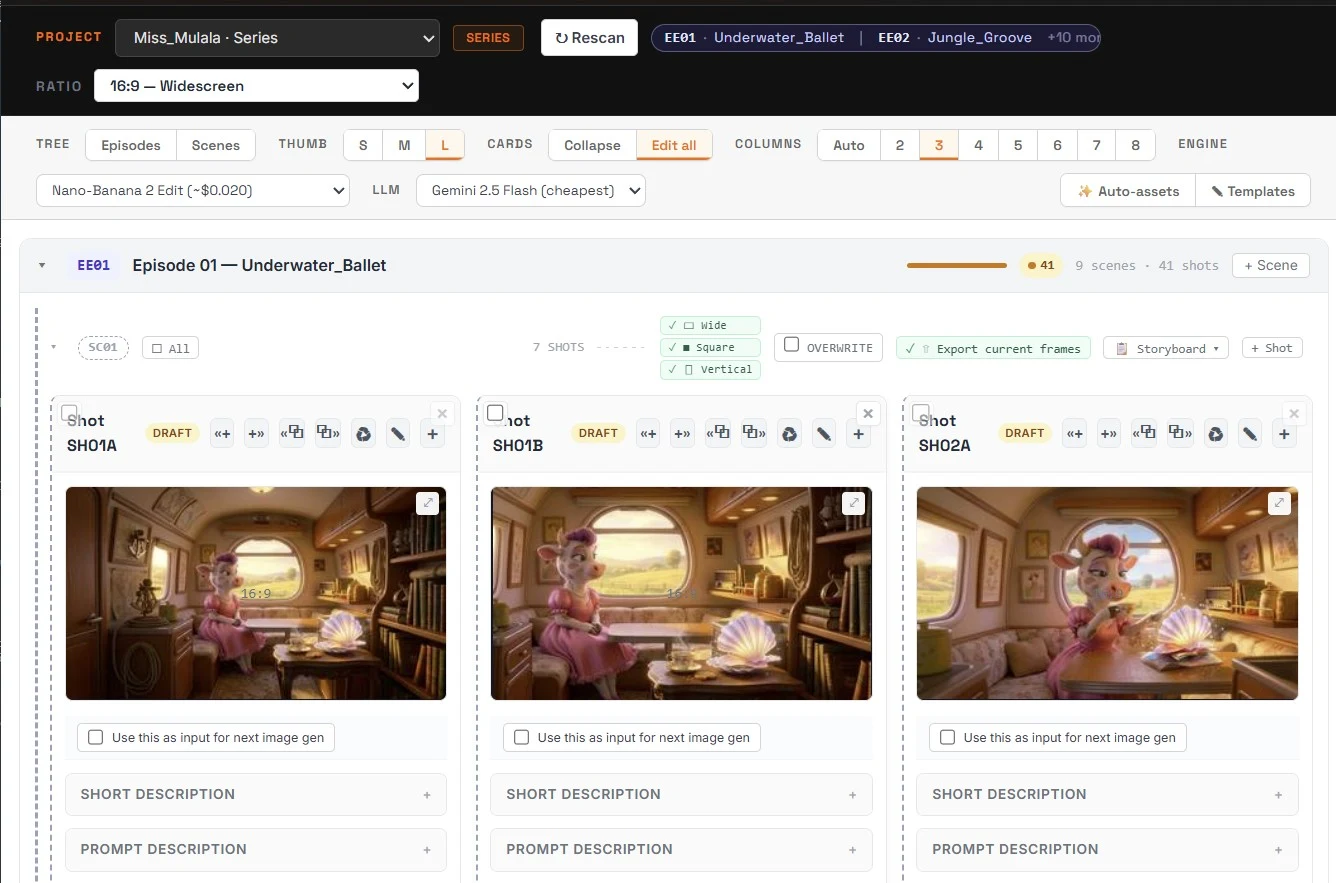
The panel walks the operator from scene → shot → enriched prompt → image, with edit gates at each step. Nothing is final until the operator says so.
- Scene-to-shot decomposition. One scene becomes 4–12 shots with suggested types and intent. Editable inline.
- Cast-aware enrichment. The prompt for every shot pulls from the canonical cast and active episode variants, no manual reference image hunting.
- Camera language presets. "Anime push-in", "documentary handheld", "comic-flat 2D". House styles distilled into reusable directing vocabularies.
- Print-ready export. PDF storyboard sheets with shot numbers, dialogue, action notes. What a director actually needs in the room.
04What's next
We're working on a shot-bank, a project-level library of approved shot grammars that learns from director feedback ("more push-ins", "less symmetric framing"). The board generator gets opinionated about your show over time, instead of being an empty prompt box on day one.