
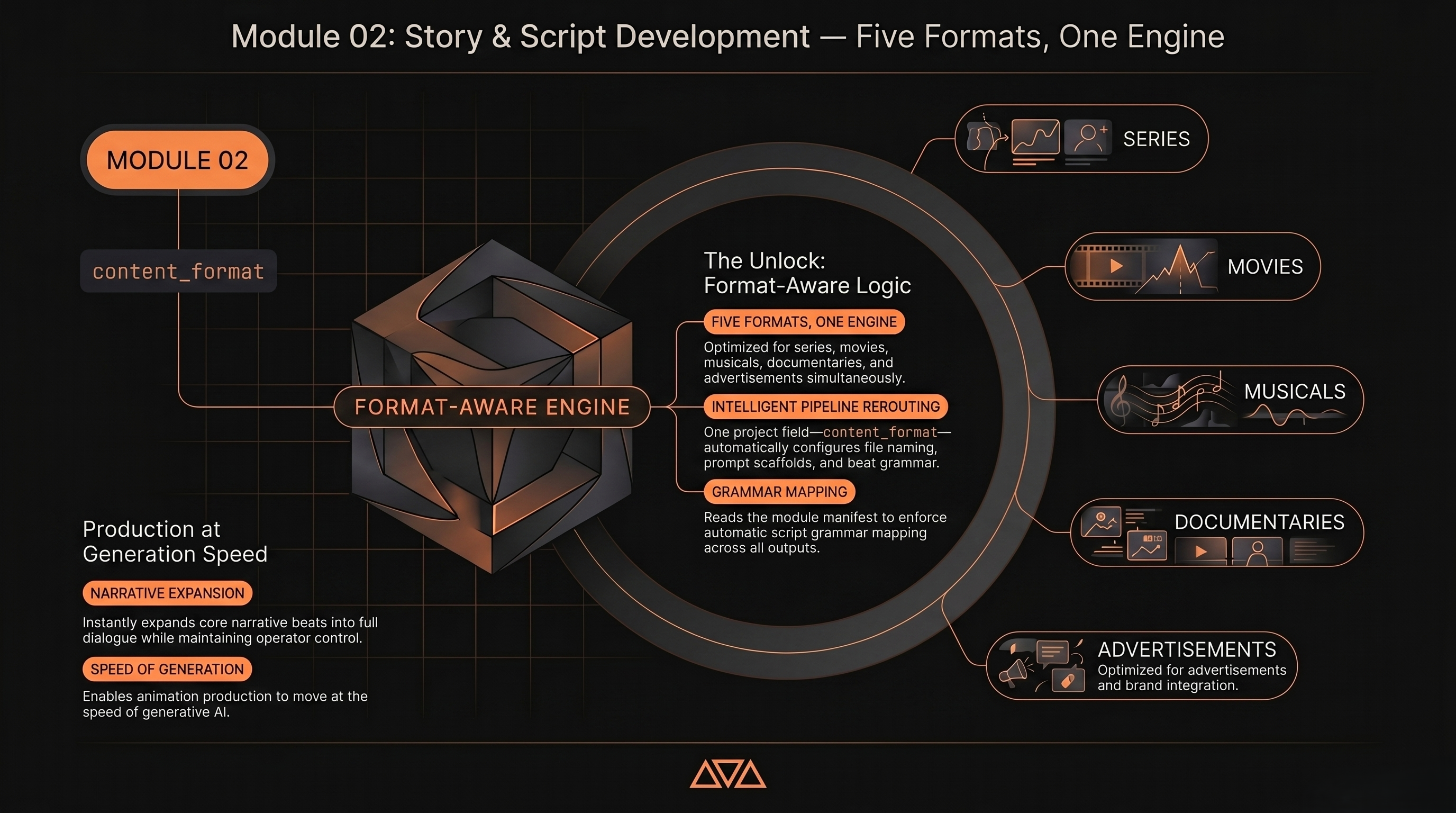
Most "AI script tools" assume one shape: a feature screenplay. Real production has at least five, and the joints between them are exactly where pipelines break. Module 02 makes the format part of the data, not part of the tool.
01The problem
A series episode is split into cold open / acts / tag. A musical track is split into verses, chorus, bridge. A commercial breaks at hook, pitch, CTA. A documentary breaks by topic and B-roll. The vocabulary is different, the beats are different, the file outputs are different. Most teams maintain five different scripts to handle this, or pretend everything is a movie and patch the joints later.
We did neither. We made the format a property of the project, and taught the same expansion engine to obey different rules under different presets.
02The approach
Each project carries a PROJECT.json manifest with a content_format field. That single field reroutes the whole pipeline. File naming (EPISODE_SEQ01 for movies, EPISODE_SEC01 for musicals), prompt scaffolds, beat grammar, and downstream module behaviour. The expansion runs in four steps (premise, beat sheet, scene list, scripted dialogue) but each step asks format-specific questions.
The musical preset, for example, generates a FULL_SONG_SCRIPT.txt as the single source of truth and treats every section as a verse-aware unit so chorus repetition stays musically coherent. The documentary preset asks for sources and B-roll cues alongside narration. The series preset enforces an act structure and watches the runtime budget.
"Format-aware was the unlock. The minute we stopped pretending a music video was a short film, the whole pipeline got faster."
03Inside the control panel
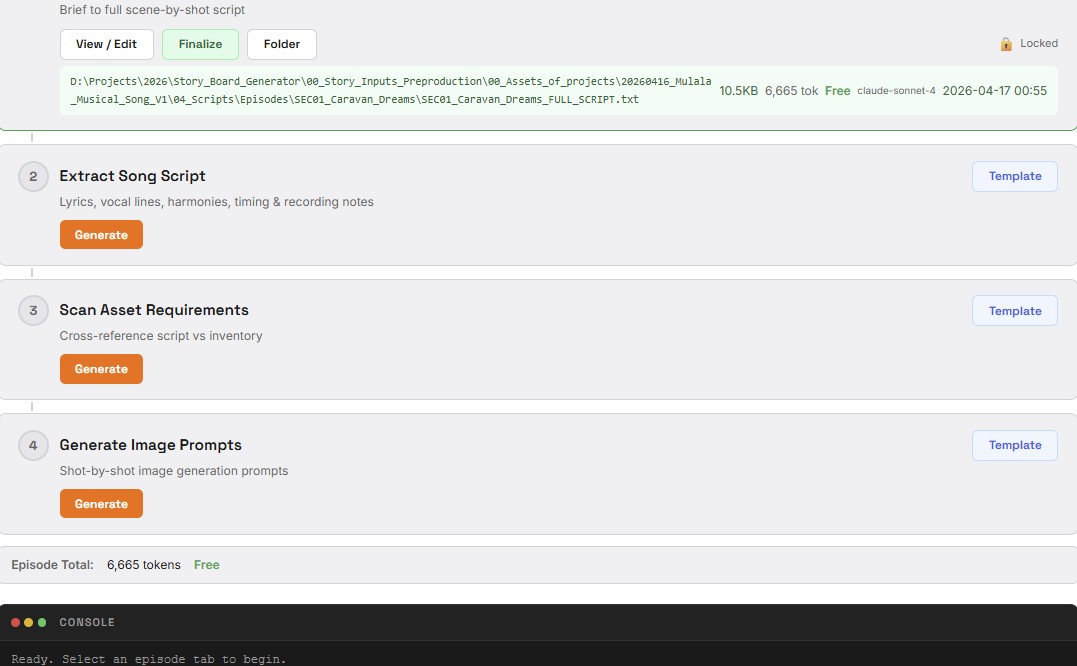
The panel surfaces the four expansion steps in a fixed left-to-right flow. Each step writes its output to disk before the next can run, so the operator can stop, edit, and resume without losing state.
- Format selector. One dropdown rewires the entire prompt graph and file-naming convention. No code change required.
- Step gating. Step 2 won't run until Step 1 is on disk. Errors stay local, a failed Step 3 doesn't corrupt Step 1.
- Voiceover extraction. Pulls speaker-tagged dialogue out of the script in a format ready for TTS, with line IDs that survive into the storyboard.
- Asset scan. Cross-references the script against Module 01's cast. Flags any character or prop that hasn't been sheeted yet.
04What's next
The active push is cross-format adaptation. Taking a feature treatment and re-projecting it as a six-episode series, or a 90-second commercial, with the manifest doing the heavy lifting. Same story, different shapes, no rewrite. After that: a presets registry that lets a studio ship its own house format alongside ours.