
A reliable animation pipeline does not start with a script. It starts with a cast. Characters, props and environments that already know who they are, so every downstream tool can reach for them by name.
01The problem
AI image models are happy to invent a hero on the fly. The trouble is they invent a slightly different hero every time. Hair colour drifts, jacket buttons multiply, the dog grows a tail it didn't have in the last shot. Continuity used to be a department. With generative tools it has become an emergency.
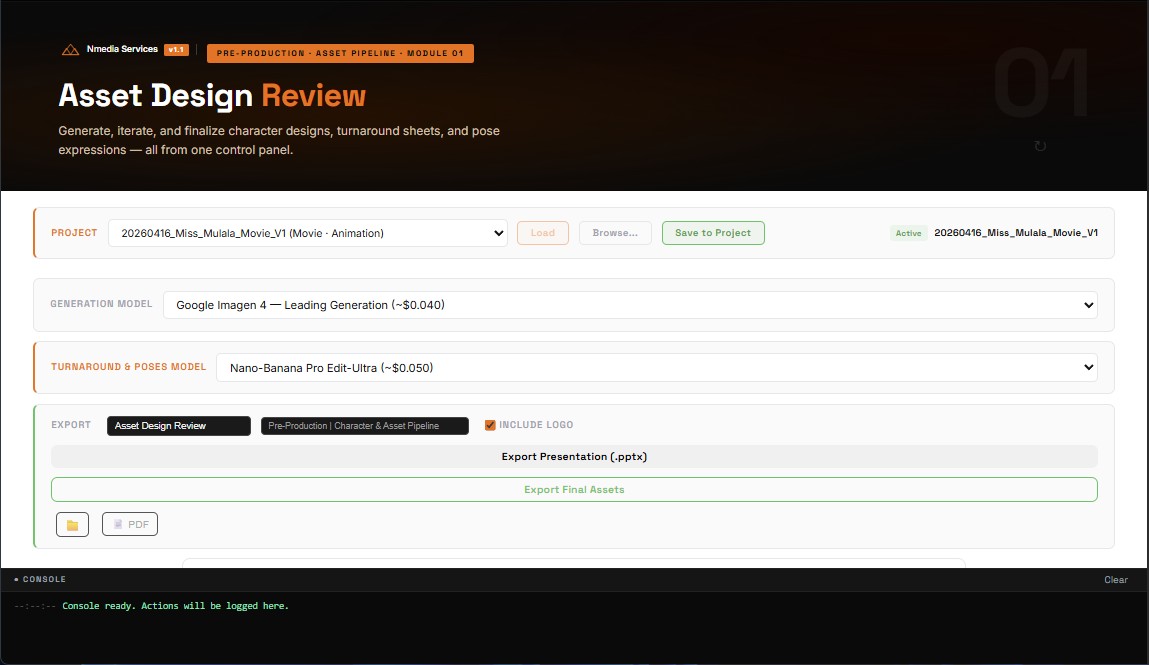
The fix is older than animation itself: a character sheet. A canonical front / side / three-quarter / back view, with palette swatches and a written description specific enough to be reproduced on demand. The same logic applies to props and environments. Module 01 builds those sheets, at scale, in a single panel, before the storyboard team even opens their tablets.
02The approach
The operator drops a one-line concept. An LLM (routed via OpenRouter so the team can swap models without code changes) expands it into a structured cast list. Names, archetypes, palettes, silhouettes. The same prompt graph then generates each character's turnaround, each prop's three-view, each environment's establishing plate.
Crucially, the text descriptions are written first and the images are conditioned on them. That means when continuity drifts mid-production we can re-roll a single image without re-rolling the design, the canonical text is the source of truth, the image is just the latest render of it.
"The cast becomes the contract. Every other module signs it before it makes a frame."
03Inside the control panel
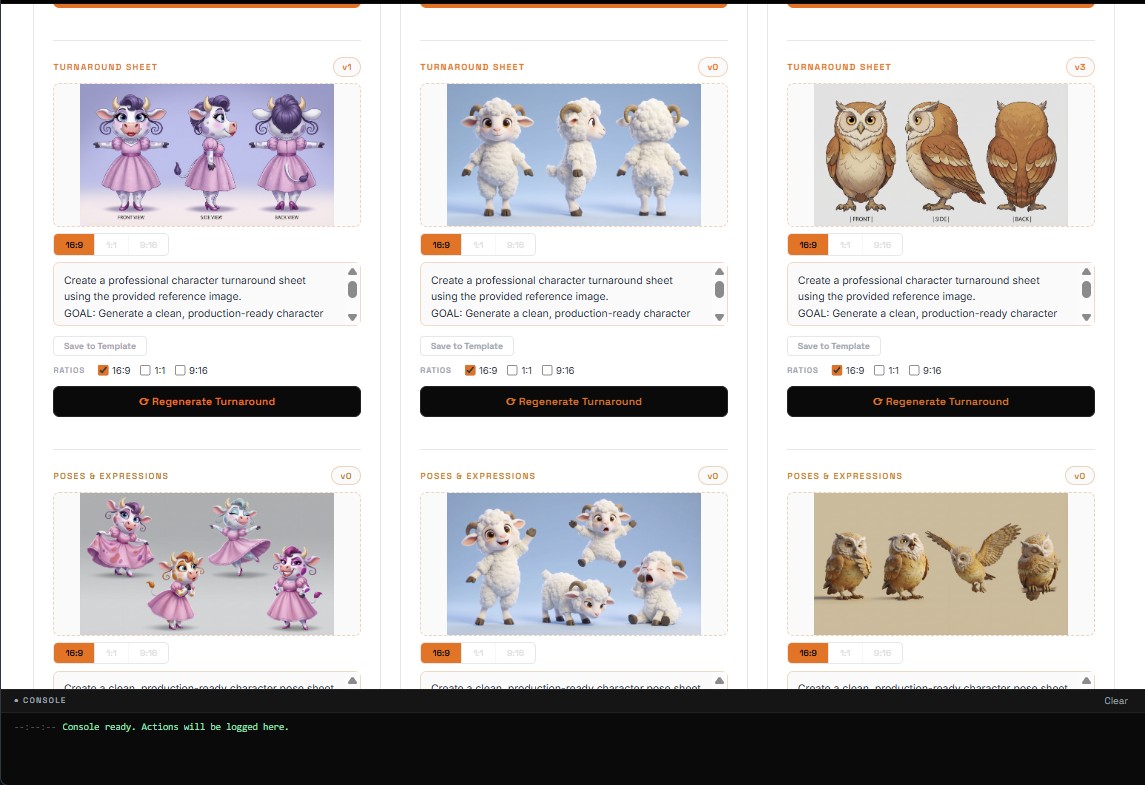
The interface is deliberately category-led. Three columns, three asset types, one shared review flow.
- Turnaround switcher. Pick a ratio per character (1:1, 16:9, 9:16, custom), the panel re-renders only that card without disturbing the rest of the cast.
- Locked descriptions. Every sheet stores its canonical text. Re-rolling an image is one click; re-rolling the design is intentional.
- Cross-module export. Output sheets land in a structured folder that Modules 02–07 read directly. No manual re-uploading.
- Versioned overwrites. Every regeneration moves the previous render into
versions/. Nothing is lost when an art director changes their mind at 11pm.
04What's next
Asset Design is upstream of everything else in the Nmedia Services pipeline. The next iteration adds asset relationships. "this prop belongs to this character", "this environment is night-only", so downstream modules can auto-populate scenes with the right things without the operator having to remember which file lives where. The cast becomes a small graph, not just a folder.