
Every animation project starts the same way: a great idea, badly described. The job of Module 00 is to take that mess (the email chain, the reference deck, the half-written treatment) and turn it into a brief the rest of the pipeline can actually consume.
01The problem
Pre-production is where most studios bleed time. Not on creative choices, on translation. A producer reads a client email. A creative director writes a treatment from it. A coordinator restructures the treatment into a brief. A writer rebuilds the brief as a script. Every hand-off is a re-typing exercise, and every re-typing is a place where intent gets lost.
Worse: by the time the brief reaches the storyboard team, nobody can say with confidence whether the show is supposed to be a 3D Pixar piece, a webtoon, a cel-shaded anime, or a live-action commercial. The visual treatment was a vibe in someone's head three Slack messages ago. That's not a creative problem. It's a data-loss problem.
02The approach
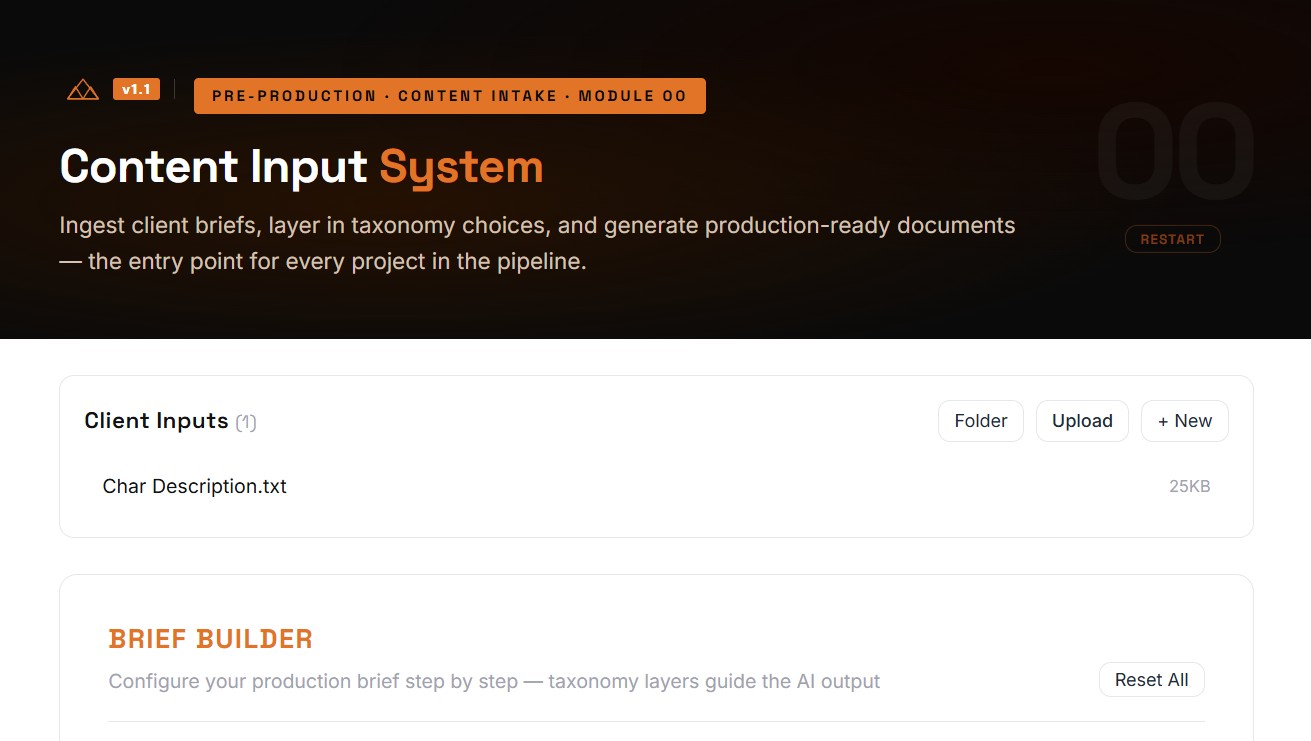
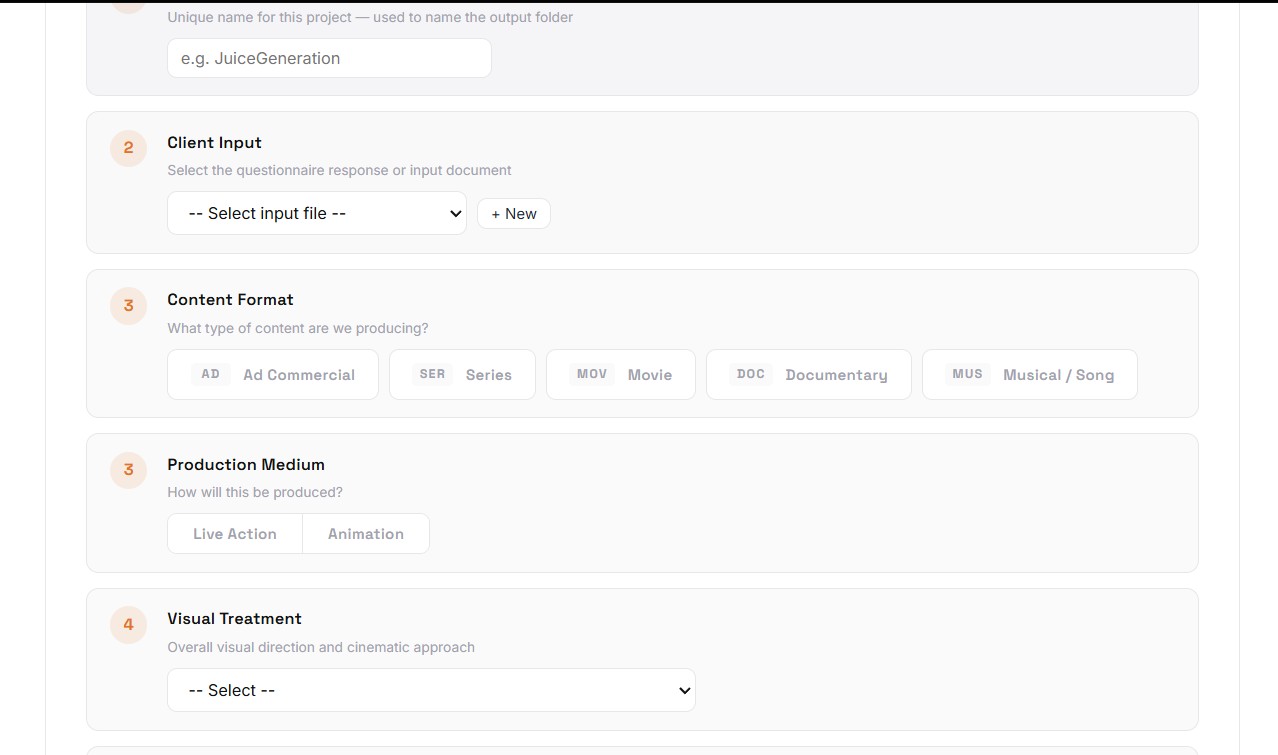
Module 00 collapses intake into a single Flask control panel that does two things well. First, it accepts raw client material. Text briefs, questionnaire answers, reference images, and stores them as a versioned workspace. Second, it walks an operator through a stepped brief builder: pick a content format (Series, Movie, Musical/Song, Documentary, Ad/Commercial), then layer in seven taxonomy axes, visual treatment, art style, motion language, genre, age group, tone, mood.
Each taxonomy choice is backed by a real document, an actual style guide that gets injected into the LLM prompt. "Anime" isn't a vibe; it's a 400-word treatment of cel-shaded technique, vibrant palette and dynamic action lines. The brief generator reads all of it as context, not as a label.
"The intake step used to be a coordinator with a Word doc. Now it's a manifest the rest of the studio can read."
03Inside the control panel
The panel is built around a single workflow: drop in client material, configure the build, generate, ship downstream. Everything else is a side road.
- Stepped brief builder. Project name → client input → format → seven taxonomy layers → model → generate. Each step gates the next, so an operator can't accidentally ship a half-configured brief.
- Production buckets. Five format presets (Ad, Series, Movie, Documentary, Musical/Song), each with its own brief template that the LLM fills in. The structure is the contract.
- PROJECT.json manifest. Every generated brief writes a canonical manifest into its project folder. Format, version, taxonomy, source files, the rest of the pipeline (M01–M07) reads this one file to know what kind of project it is.
- Workspace flush + load. Save-and-flush archives the current intake into a zip; load-archive restores it. Multiple projects, no cross-contamination, full auditability.
04What's next
The next iteration adds a questionnaire-first intake: rather than starting from a client email, the studio sends the client a smart form whose questions are themselves taxonomy-aware. The output of the form lands as a pre-filled brief builder. After that: multi-language intake. Clients write in their own language, the brief is generated in production English, no translator round-trip required. The pipeline keeps moving the bottleneck upstream until there isn't one.